
Offshore Wind's Challenges
Plus more on Venezuela, Urbanism, Nuclear, Data Centers, EVs, Solar and Batteries

Hi everyone,
It feels like 2026 is now fully up to speed, with lots of signposts stories to flag for you. I’m profiling the offshore wind industry this issue, though lots to say about nuclear, bits on data centers (see The Grid), Venezuela, and my new favourite passion outlet: urbanism. After all, if we are going to solve for emissions, it has to involve solutions in cities. Be sure to skim through to the bottom for EV insights.
Thanks for continuing to read and share this with others who may be interested.
Peter
Peter’s Takes: Offshore Wind Still Challenging
Offshore wind continues to struggle, though there are a couple of bright spots. Overall, offshore wind is struggling, not the least because of political interference in the US. Making headway has been a challenge over the last couple of years, owing inflationary cost increases and higher borrowing costs. Add in competition from Chinese developers. When I see stories about offshore wind, I am often struck by the sheer size and scale of all the equipment needed. Huge docks, custom giant ships and cranes, servicing vessels, cable laying vessels, specialized blade maintenance work and the list goes on. And turbine sizes keep getting bigger, requiring ever bigger manufacturing facilities. All of these make it much harder for the technology to scale as compared to, say, solar.
The Somewhat Good: in the UK, where 8.2GW of capacity won contracts-for-difference. Another milestone: a 20MW turbine is installed offshore China.
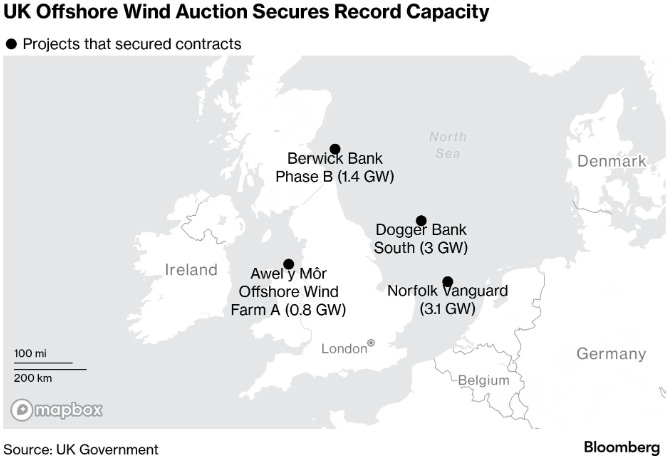
Offshore wind hopes boosted as massive UK auction smashes records after years of failures. The success can be attributed to developers getting paid better than in previous auctions - a cost ultimately passed onto consumers. RWE secured almost 7 of the 8.2GW awarded. See map below courtesy of Bloomberg Green. Yet challenges remain. Time will tell if all these get built. For those companies that were not successful in the auction, many are canceling their plans. The reasons: “increasingly deteriorating conditions such as significant cost increases across the supply chain, higher interest rates and ongoing project implementation risks.”
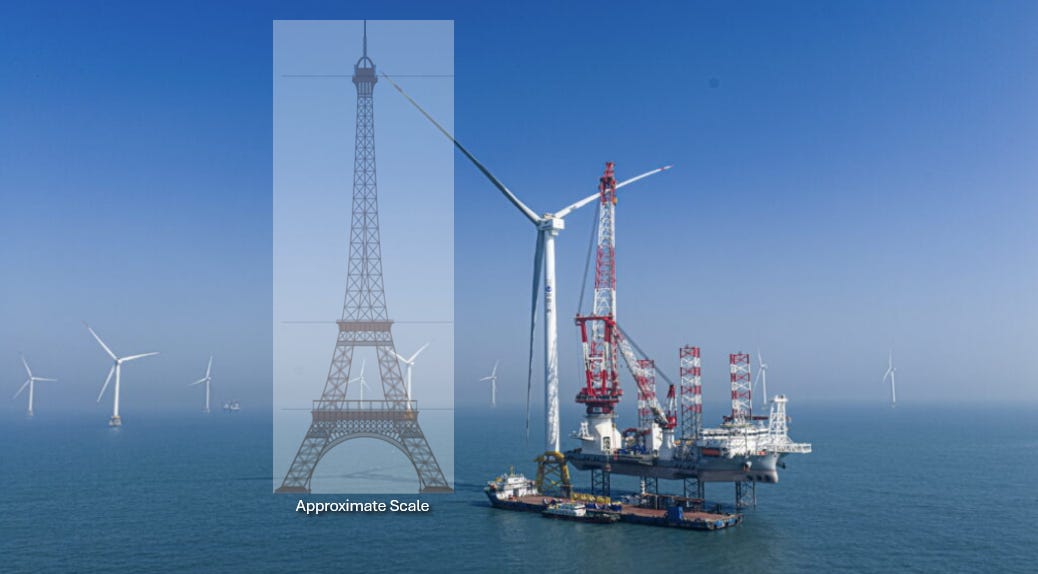
World’s First 20-MW Offshore Wind Turbine Installed in Waters near Fujian. The scale of this turbine is not to be missed. The hub height is 174 meters, equivalent to a 58-story building! The blades are 147 meters long. Yes - that is a crane ship jacked up out of the water! I added the Eiffel tower just to see. Video here.
The Bad: Generally still bad for US offshore wind, though 3 of 5 farms won injunctions to allow construction to proceed after Trump ordered a stop.
After 4 of 5 offshore wind farms challenge Trump administration stop work order, three win injunctions allowing construction to proceed. What a mess. Developers were losing $1-5 million per day. Plus specialized vessels needed are tightly scheduled for projects around the world. Missing your window is very bad. The three now back to construction: Ørsted’s Revolution Wind, Equinor’s Empire Wind and Dominion’s Coastal Virginia.
Finance & Sentiment
On Venezuela, Exxon says it is “uninvestable” and TotalEnergies says it is in no rush to go back there. For some deeper insights on the history of nationalization of oil assets, suggest reading this piece by Chartbook. Politico also offered more thoughtful insights. As for the impact to Canada oil sands production, if anything, it will be many years out and muted at best. Remember, only about one fifth of oil sands production makes is to the US Gulf coast where is would compete with Venezuelan oil. I just don’t see the country addressing the risks to investment in a meaningful way on the longer time horizons needed, even for private capital, such that production rises significantly. One thing I learned in all this: methane emissions there are a big problem. Add it to the list of why not to expect big investments anytime soon.
EU Carbon Border Adjustment Mechanism Goes Live, Raising Trade Stakes. I have posted on this before. I’ll be watching how this changes trade, especially from emerging economies. This whole idea: plugging the so called “carbon leakage” where goods imported into Europe are produced more cheaply where there is no carbon pricing. The scope so far: importers must report and pay for the emissions embedded in products such as steel, cement, aluminium, fertilisers, electricity and hydrogen.
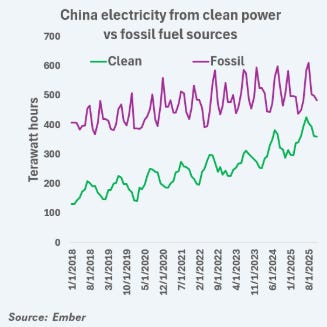
Reuters offers this: The 2025 energy transition in eight charts: clean wins, dirty setbacks. My favourite is clipped below - shows how clean electricity is soon matching fossil fuel:
What does a just transition from high dependence on coal look like in Poland? Read this piece from Canary Media for insights on the challenges and progress. Among the answers: economic diversification into the knowledge/tech economy.
Trump Pulls U.S. Out of Major International Climate, Energy and Sustainable Development Organizations. Here is a short version. But to really understand it what it could mean for climate action, consider reading this longer piece by Carbon Brief.
Hydrogen
Chinese steel giant starts up ‘near-zero-carbon’ production line, based on hydrogen for direct-reduced iron.
Carbon Capture & Removal
Microsoft signs record soil carbon removal deal to cut emissions. The deal with Indigo helps framers implement regenerative agriculture practices. They’ve been at it for several years already, and it’s nice to see this reaching the scale enabling big corporate investment. Hear directly from a farmer here.
Urban Design & Buildings
Many Americans Are Open to Car-Free Living. This comes from one of the best experts on transit: Jarrett Walker. In his blog post, he highlights the findings of recent research coming out of Arizona State University:
We find that nearly one fifth of urban and suburban US car owners express a definite interest in living car-free (18 %), and an additional 40 % are open to the idea. This is in addition to the small share (10 %) of urban and suburban US residents currently living without a car.
Why the [US] economy is so broken. Justine Underhill offer another great video worth 30 minutes of your time. I do not buy into the “abundance” thinking (“adequate” would be just fine), though there there are some aspects of it that make it particularly fitting at this juncture.
Congestion toll in NYC: Traffic down, revenue up. The numbers are truly impressive: $550 million raised, traffic down by 11%, with 27 million fewer vehicles entering the zone, traffic speeds up by 28-51%, economic indicators up, serious injury crashes down 9%, noise complaints down by 23%.
The Grid
Illinois sets 3-GW energy storage target, requires utilities to develop virtual power plants. An outstandingly fine example of good policy guidance to utilities: do more to leverage demand response and to harness distributed resources like EV charging, smart thermostats and home batteries. We should expect our policy makers in other jurisdictions to do likewise.
Trump administration pushes PJM to hold ‘emergency’ auction to supply data centers. Finally an article the explains what has been going on in PJM, a grid in the US covering 13 states and serving 65 million people. As for this auction push, it so far seems like politicians wanting to look like they are doing something about rising electricity prices. In other words, mostly posturing.
American Electric Power signs $2.65 billion deal for fuel cells. A solid oxide fuel cell power plant? New one on me. Start up Bloom Energy is the provider. Another one to watch. How do they work? Bloom’s fuel cells convert fuel and air into electricity, without using combustion and can flexibly run on natural gas, biogas, pure hydrogen, or hydrogen blends.
AI data centers are forcing dirty ‘peaker’ power plants back into service. I didn’t know there was such a thing as an oil-fueled peaker plant. It is one thing to run one of these every now and then, but entirely another to run one full time. I can’t see that being sustainable, let alone the pollution.
US utility TVA’s gas-fired power generation tops 3.6 GW after latest approval. Shows how some utilities are still reaching for gas-fired as the way to go.
Google acquires Intersect Power for nearly $5 billion. When you have the cash, why not? Expect to see more deals like this by others.
Intersect Power is expected to focus on “energy parks” that co-locate hyperscale datacenters with generation and battery energy storage assets. The “behind-the-meter” approach to bringing solar and storage onsite helps mitigate public grid congestion and interconnection delays, making solar and storage a weapon in Big Tech’s arsenal to scale more rapidly than the conventional utility-operated grid can allow.
Nuclear
Big data turning to nuclear. This from Bloomberg Green:
Until now, Meta has been the most cautious nuclear investor of its tech peers, brokering just one major deal to buy power from an existing atomic power station. By contrast, Amazon bought a stake in the reactor developer X-energy and put up the money for its first power plant; Microsoft pumped billions into reopening the working reactor at Three Mile Island; and Google is both bringing another reactor back online and investing in the next-generation reactor company Kairos Power. On Friday, the Facebook owner announced a sweeping deal to buy power from the nuclear utility Vistra, help build reactors with the Bill Gates-backed startup TerraPower, and pay cash upfront to finance the purchase of fuel for microreactor developer Oklo’s first power plants in Ohio.
Remember that of all the US nuclear tech companies advancing deals, only two have approved designs from the US Nuclear Regulatory Commission: Westinghouse and NuScale. The former’s AP1000 is supremely expensive to build and the latter has failed to land any deals through to construction, even though it has been in business for 18 years.
Meta inks nuclear deals for up to 6.6 GW from Oklo, Vistra, TerraPower. Meta will help develop small modular reactors planned by Oklo and TerraPower. The latter is backed by billionaire Bill Gates. Here is a short explainer video on TerraPower’s Natrium™ Reactor and Energy Storage System.
US awards $900 million to two nuclear fuel makers. A move to reduce reliance on enriched uranium from Russia. This from Bloomberg Green:
The funding for Maryland-based Centrus will go toward the development of next-generation reactor fuel, according to the Energy Department, which is announcing the awards later Monday. Funding will also go to Peter Thiel-backed advanced nuclear fuel enrichment startup General Matter and to a subsidiary of Orano SA, which is planning an enrichment facility in Tennessee.
China Winning Construction Race As Work Begins On Two More Nuclear Power Plants. The link is from Dec, 2025 and behind a paywall, but the main point: China has 35 nuclear plants under construction - more than the rest of the world combined.
New York Gov. Hochul expands nuclear aspirations to 8-GW fleet. They should be thinking of how to scale many, many small modular reactors to hit that goal. Not the big ones prone to cost and schedule over-runs. When I say small, I mean smaller than Ontario’s 300MW units that are $6-7B a piece. Better yet, why not look to solar paired with batteries?
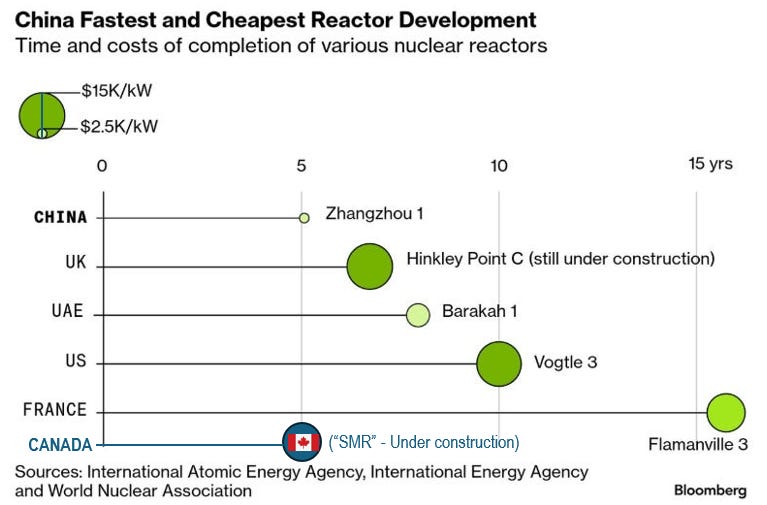
Ontario utility wants to double the asking price of nuclear, while US wants reactors on the moon. I’m kinds disappointed I couldn’t find any decent free articles on this from a Canadian source. Had to go all the way to Australia. I’m also not surprised, when the costs for those units are as high as they are. Reminding you of this chart to which I added Canada’s SMRs. And as for Trump pushing the Westinghouse’s AP1000 units. Look at Vogtle 3. That is an AP1000.
Energy Storage
Sodium-ion battery cells already near lithium-ion cost parity, set to get cheaper. Frankly, whenever I see cost reduction projections out to 2050, by an academic outfit, I say to myself: really?!
While SIBs are already cost-competitive with lithium-ion batteries (LIBs), their gravimetric energy density still lags behind.
China connects world’s largest vanadium flow battery project. A five-hour battery: 200 MW/ 1,000 MWh. China seems to be the only place advancing vanadium redox flow batteries.
China’s connects the world's first GWh-scale supercapacitor-energy storage project. I can’t say I’ve ever hear of supercapacitors being put into energy storage projects outside of China. This one’s size: 2 hours - 500 MW/1 GWh.
Germany adds 6.57 GWh of battery storage capacity in 2025, total capacity hits 24 GWh. The amount added in the US: perhaps 73 GWh. In Canada: zero. But some is said to be coming in 2026 and 2027.
Solar and Wind
India tenders 2.45 GW solar power projects with battery storage. The march of solar in India continues.
Major solar manufacturers in China report steep full-year losses. It is a story of overcapacity.
Google Buys 1.2 GW of Carbon-free Energy to Power Data Centers Across U.S. A great example of ambition at work. Google wants to have carbon-free energy 24/7 by 2030. It has signed up over 22GW of clean electricity since 2010.
Listen to Zero (35 min): How cash-strapped Argentina became a bright spot for renewables. Argentina has seen a remarkable increase in clean energy over the past decade. It has gone from practically zero to almost 18% of its electricity sourced from renewables. Yet now, bold policy moves are needed to unlock sustained progress, including to investment in transmission and distribution infrastructure. Sounds familiar, eh? Oh, and how about stop giving away electricity for free.
Offshore Wind Turbines in 2025. This offers a quick rundown. Key points: China Continues Leading in Single-Unit Capacity, Vestas's 15 MW Turbine Installed at Offshore Wind Farms.
Big Tech turns to solar and storage to bypass grid bottlenecks.
Developers are prioritizing sites where they can run private transmission lines from solar facilities to data centers. This private wire configuration removes projects from public interconnection queues.
Transportation
Global EV sales reach 20.7 million units in 2025, growing by 20%. Compared to 2024, China is up by 17%, selling 12.9 million. Europe is up 33%, selling 4.3 million. North America is down 4%, yet still selling 1.8 million. These were the top 10 best sellers in the US.
Canada breaks with US, slashes 100% tariffs on Chinese EVs to 6%, with a maximum of 49,000 cars per year. It is an important trickle of affordable EVs.
Nvidia unveils 'reasoning' AI technology for self-driving cars. It has been a while since I’ve seen anything particularly meaningful for progressing autonomous vehicles. Until now. This will be interesting to see how it works.
Quebec’s Letenda is building new 30-ft electric midibus built for Canadian winters
Another Chinese EV giant begins testing solid-state batteries with 620+ miles (1000km) range.
Another great collection of fascinating news and developments, along with your useful contextual remarks. Thank you Peter!
I'm glad to hear of your urban passion. I've been keenly watching the progress brought on by New York's congestion pricing mechanism and I've wondered if Calgary, with our limited number of access points into downtown, might benefit from a similar program.
My father was an accountant, so I come by my preference for market mechanisms honestly. A decade ago I made some efforts to foster conversations on carbon pricing with folks in the business community, and among Canadian political conservatives.
https://corporateknights.com/leadership/turning-manning-networking-conference-green/